Boredom and a Scientific Game of “Would You Rather”

Have you ever played the game “Would You Rather?” It’s something kids used to do (maybe they still do, if they’re not on SnapChat) to amuse themselves when a moment of boredom came along. The game consists of asking each other questions like, “Would you rather be rich and ugly, or poor and gorgeous?” or “Would you rather go completely bald, or have back hair to rival a grizzly bear?”
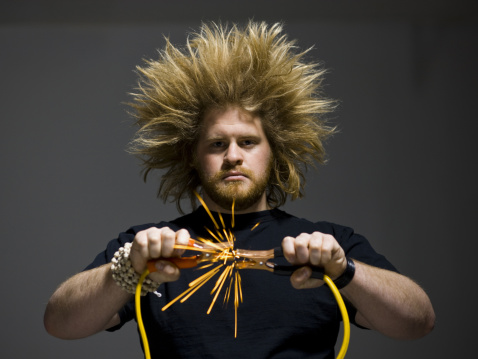
shock_hairRecently some researchers at the University of Virginia decided to play a scientific game of “Would You Rather.” Of course, they didn’t call it that, but they created a study to find out if college students would rather be left alone in a quiet room for 5-15 minutes, or give themselves an electric shock.

The results do not bode well for the future of humanity.

Most of the participants in the study preferred the electric shock! (You can listen to an interview about this study here, with a few more details about how it was conducted – no electricity puns intended). The study’s author is a professor of psychology, and he attributed these results to the rise of social media and smart phones, essentially saying that people are losing the capacity or willingness to sit quietly with their own thoughts without being entertained.

So…what’s wrong with a little boredom?

The day after hearing about this study on the radio, I had to spend 3 hours at the DMV getting a new driver’s license. When I arrived first thing in the morning, the line was already snaking around the outside of the building. The wait was an hour and a half in the hot sun just to go inside the building and take a number. Then you got to go to the actual waiting room and sit until your number got called. I was G088.
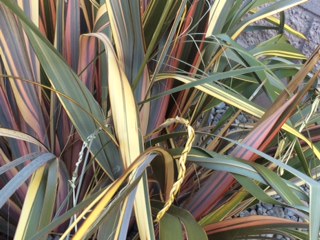
braidedplantatDMVThe DMV is a pretty good place to do some people watching, if you don’t have your head buried in an iPhone the whole time, so I determined that I was going to practice just standing in line and being a little bored. I’m always feeling like I’m too busy, so here was someone giving me permission to take a break. I can’t say I never checked my phone, but I kept it stowed away for the vast majority of the time I was there. I was just about the only person around not texting, Facebooking, or emailing. Someone from earlier apparently got so uncomfortable with the boredom that they decided to braid some plant leaves together (must not have had Angry Birds).

But, I enjoyed the breeze, the sky, the real birds, and the feeling of my feet on the ground standing in Mountain Pose…in line at the DMV.

I feel fortunate to have a meditation practice to rely on for all the discomforts of daily life. Boredom is one of those things that you will inevitably encounter, sooner rather than later, if you take up meditation. It’s not a problem. In fact, it’s a good thing! It means that you’re not filling up the space in your mind with all kinds of stuff, for once. Sure, some of that stuff is helpful and necessary, but a lot of our mental activity is just fluff. When we pause for a little while from our usual mode of working or being entertained, that becomes pretty evident. And when we can stop being entertained by our worries and restless thoughts for a moment, that letting go gives peace the chance to show up for a visit.

I heard a talk once with meditation teacher Pascal Auclair, in which he said, “Peace is an acquired taste.”

That one stopped me in my tracks. Don’t we all want peace?

cookiemonsterdharmaBut, he’s right – peace is not the same as excitement and entertainment. Much of the time, we’re not willing to settle down enough to experience this thing we want! As Pascal explained in the talk, peace has a kind of neutral tone to it. It’s not an exuberant high, and it’s not a sorrowful low. It’s a lot closer to the ability to just be with whatever the moment is offering up.

Here’s a practice for you: next time you get the opportunity to be with boredom, let yourself experience it fully!

  • Notice that feeling of “pull” as you are drawn to a hundred new ideas for what to do with the moment (“Should I do this or that? I wonder what’s on Facebook? Do we have any of those cookies left?).
  • When you notice the boredom, are there any other feelings in the background (like pressure to be more productive, anxiety about wasting time, worrying that you’ve forgotten something)?
  • Now pause and hear any and all of the sounds around you. Notice the shapes and colors of what you are seeing. Feel where your body is touching a chair, or your feet are contacting the ground. Sense the breath rhythmically moving in and out of you.

Are you still bored?

Happy Interdependence Day!

mesh-internetYes, I spelled that correctly.

While we’re celebrating our nation’s history, freedom, and independence this weekend, why not pause to contemplate interdependence as well.

Interdependence acknowledges the connections between us all – that our actions and attitudes affect each other, for better or for worse. We are all in this together.

This past weekend, while teaching a Yin Yoga Teacher Training in Las Vegas, I was reminded of this connectivity as we discussed the anatomy of fascia. Fascia is, in fact, connective tissue! It plays a crucial and largely unsung role in the body, being a stabilizing net for our muscles and joints, helping maintain our structure and hold us in our shape, and even transporting water, hormones, and nutrients through the body, like your own personal internet. Fascia is one reason why a tight calf muscle can contribute to low back pain or achy shoulders, for example. None of our parts work in isolation. Nature is built on interdependence.fireworkswater

In the words of Chief Seattle:

“Humankind has not woven the web of life. We are but one thread within it. Whatever we do to the web, we do to ourselves. All things are bound together. All things connect.”

So, Happy Interdependence Day! (And Happy regular 4th of July, too.)

Jack Kerouac on Simplicity

kerouac_simplicity“One day I will find the right words, and they will be simple.” – Jack Kerouac

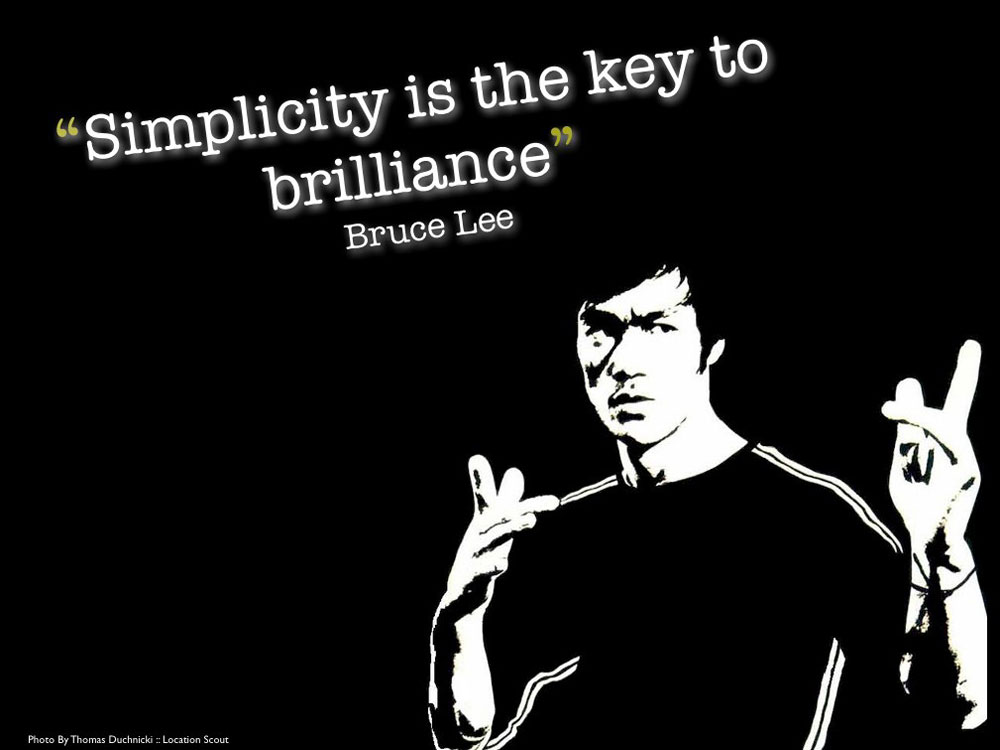
And bonus, Bruce Lee!  Keepin’ it simple. And brilliant.Bruce-Lee-Simplicity-is-the-key-2-brilliance

Simple Does Not Mean Simplistic

In fact, it often takes a great deal of experience to pare things down to their essence. To clear the unnecessary clutter, to silence the extra noise.

simplicity_leonardodavinciMeditation is ultra-simple, but it’s not easy, is it? The same goes for many of the “basic” yoga poses, if we are paying attention.

When something is simplistic, it is trite, shallow, and inauthentic. True simplicity is quite the opposite – it is deep, satisfying, and often profound.

Bells and whistles are nice, but every once in a while, it’s good to let go of complication and embrace simplicity. It feels refreshing.

Practice Notes – Simplicity 2 (the sequel)

It’s officially summer movie season, which means sequels! Ok, so before you get too excited, this sequel is just further thoughts on a previous post, and does not involve a car chase or mega-shark-earthquake-alien-baby type situation. Just getting that out of the way…

It’s quite the opposite, actually. This post is about embracing simplicity in your yoga practice, in order to better facilitate a meditative state of mind. Earlier, in Practice Notes – Simplicity, I wrote about how framing the asana practice around a handful of basic poses helped me experience greater continuity between the asana part of practice and the sitting meditation that I did right after the poses.

wetstones_simplicityIn addition, I like to start my practice with 10 minutes or so of slow walking meditation (in the vicinity of my yoga mat), so the postural yoga practice is bookended by two forms of meditation. On a meditation retreat in the Vipassana (Insight) tradition, you alternate sessions of sitting and walking meditation throughout the day, weaving together meditation-in-action and meditation-in-stillness.

So, here’s how this goes in practice: choose 4 poses that make sense together and repeat them 3 times (in the same order).  The first time, you may pay a good bit of attention to particular elements of alignment that you’re working on, but with each repetition, let your approach be simpler, your mental instructions sparser, and your experience more internal. Choose fairly basic poses that you know you can do without strain. Hold each pose for a good while. Slow the practice down. Depending on the poses you choose, this postural yoga practice will take 20-40 minutes.

I have been practicing with this little template for a few months now. For me, it’s physical enough to awaken awareness in the body, and it does prepare me well for sitting. Sometimes the pose selection results in a pretty vigorous session, but it’s so focused because of the simplicity of the sequence and the repetition. And, on the second and third repetition of the pose, I often find a little more ease and sweetness in the posture, as the immediate sense memory allows it to come more easily.

You might be thinking, “how can you have a well-rounded yoga practice if you only do 4 poses?” Good question! There is room for variety here, because tomorrow you can choose an entirely different set of 4 poses that address other parts of the body. If you do this a few times a week, you can cycle through the whole body on a regular basis.

Here are a few examples:

Practice #1Your hips will feel open at the end, and you’ll feel grounded and ready for seated meditation.
Walking Meditation (about 10 mins)
a few rounds of Half Sun Salutations as a warm up
1. Downward Facing Dog
2. Warrior 2
3. Tree Pose
4. Malasana (Squat Pose)
Repeat 1-4 (Downward Facing Dog – Malasana) 2 more times, pause for a few breaths between each set
Sitting Meditation (about 30 mins for me, could be different for you)
Savasana (about 10 mins)

Practice #2 This one prepares the hips and strengthens the back body for sitting with good posture. It also has a few restorative poses after meditation to relieve a creaky back.
Walking Meditation (about 10 mins)
a few rounds of Half Sun Salutations and Cat/Cow warm ups
1. Staff Pose
2. Ardha Matsyandrasana (Half Lord of the Fishes Twist)
3. Locust Pose
4. Pigeon Pose
Repeat 1-4 (Staff Pose – Pigeon Pose) 2 more times, pause for a few breaths between each set
Sitting Meditation (about 30 mins for me, but you can adjust according to your practice)
Legs Up the Wall (5 mins)
Supported Bridge Pose (5 mins)
Savasana (about 10 mins)

Practice #3 This one’s a little more vigorous, and will help develop the core strength needed to sit well. It should also help calm any restlessness before you sit.
Walking Meditation (about 10 mins)
a few rounds of Half Sun Salutations, gentle dynamic twists to warm up
1. Plank Pose
2. Triangle Pose
3. Pyramid Pose
4. Warrior 3 Pose
Repeat 1-4 (Plank Pose – Warrior 3 Pose) 2 more times, pause for a few breaths between each set
Sitting Meditation (about 30 mins for me, but could be shorter or longer for you)
Savasana (about 10 mins)

Choosing the 4 poses in advance eliminates the need to sequence the practice on the fly. I know from many a past practice (which could have been Over-Complication: The Prequel) that I don’t want to be thinking and remembering and analyzing that much when I’m trying to cultivate mindfulness. Do ever just get really “in your head” when you’re doing your home practice? That’s what I’m talking about. This helps.

Try it and let me know how it goes!

Yoga that Actually Does Lead to Meditation

candle-royaltyfree_pixabayIf you’ve been reading my blog, you know that my practice centers around doing yoga in a way that really does lead toward meditation.

How many times have you heard that old truism that the purpose of yoga is to prepare the yogi for meditation? Many times, right? And how many times have you been in a yoga class that actually incorporated more than maybe 3 minutes of seated meditation? Not too often, I’m guessing.

I’m not saying that’s necessarily wrong, although as someone who is dedicated to both forms, it does feel like a bit of a disconnect. If you’re like me, you may be wondering how you can integrate meditation into your yoga practice, or vice versa.

I’ve got some tips for you in a recent article I wrote for elephantjournal.com called “3 Ways Yoga Can Help Us Sit More Consistently.” Click the link to read the rest, and enjoy!

Practice Notes: Coming Out of the Pose

When you’re practicing yoga independently at home – without a teacher, or a DVD, or audio guide – how do you determine when to come out of each pose?

yoga-clockOne approach might be to count the breaths and try to stay for a certain number of inhales or exhales. Some people time their poses – certainly we do that in Yin Yoga, since we hold the poses for so long, but as I understand it, Iyengar practitioners are supposed to hold active poses for specific lengths of time.

In practicing this morning (and at times in the past), I found myself exploring this a bit organically. Without counting breaths or using a clock, I noticed the impulse to leave the pose often seems to come when either there’s a hint of fatigue or the pleasant sensations of the pose have faded. The body is capable of being there for longer, but the mind has shifted from a pleasant or neutral reaction to an unpleasant reaction in the pose. This is related to contemplating Vedana, or feeling tone, in meditation.

Try it: come into Warrior II Pose, and stay for a while. Work with your alignment, do what you would normally do in the pose. And then notice how it is you decide when it’s time to come out – is it a loss of interest, or a sense of discomfort? (To be uber clear, I’m not talking about risky, injurious pain or extreme fatigue – just the ordinary discomfort of muscles getting stronger). Is there a change in the breath? Is there a change in your attitude or level of engagement?

How about in a pose that you savor and enjoy? Is there a desire to linger? Is there a point where you check out because the sensation is not as delicious as it was at first?

Of course, the point is not to hold poses for unreasonable lengths of time, but to use them as opportunities to reflect on what’s driving our approach to each asana. The pose can be an opportunity to study the mind’s reactivity as we embody the shapes of the asanas. Then, we’re not just “posing,” we’re truly practicing mindfulness in action.


Perfect Alignment

When I think of yoga alignment, I like to remember this quote from Suzuki Roshi:

“Each of you is perfect as you are…and you could use a little improvement.”

addie upavistha photoshoot, square

It’s not one or the other – either perfect or imperfect. We are perfectly where we are in this moment, and we are in the process of developing.

Meet yourself where you are right now.  Do your best to embody alignment in your pose, but don’t worry about perfection. Don’t worry about how it looks, but deeply sense how it feels. And remember that it will be different tomorrow. Maybe the difference will be subtle, but change is constant. The “improvement” part comes naturally and gradually over time, as we bring fresh attention to our poses, over and over again.

My idea of fun

meditatingatLimekilnMy idea of fun is pretty much practicing yoga and meditation…and sometimes it’s really fun to do these things outside in a beautiful setting.

limekilntentsOk, those are not my only interests and fun outlets in life, but when I get to combine nature + yoga + meditation, I am a happy camper!  (Sorry, I couldn’t resist the pun.)

These are some shots of our camping trip last weekend to Limekiln State Park in Big Sur, CA. I really did roll out my mat and practice, and I found that the vestibule of our tent made a perfectly secluded little spot for my zafu, so I could meditate. It’s very peaceful there, with all the campsites nestled near a babbling brook that drowns out most of the extraneous noise and soothes you to sleep at night. If you walk one direction, it leads to trails among the redwoods. If you go the other way, you walk out onto the beach with its spectacular rocks and cliffs.

bigsurinaprilrockbalancelimekilnAnd, to be honest about what a big yoga nerd I am…I also enjoyed lounging around the campfire reading Charlotte Bell’s Yoga for Meditators: Poses to Support Your Practice.

There you have it – that’s my idea of fun.

Audio Guided Relaxation – Extending the Exhales

breatheThis past weekend, I started experimenting with recording myself doing some of my favorite guided relaxations and breath exercises. I teach these in my yoga classes all the time, so I thought it would be fun to have some of them to share beyond the studio.

My husband was the guinea pig, and he came into my home yoga space to let me guide him through a few breath exercises while I recorded. I didn’t script these in advance, I just improvised them, because I wanted it to feel like being in a real class.

So, here is one entitled “Extending the Exhales.” This one is especially good to do if you’ve been feeling stressed or overstimulated. Towards the end, it includes the affirmation, “What I need comes to me in the right moment.”

Audio Guided Relaxation – Extending the Exhales

Enjoy and let me know what you think!

P.S. There is another one called “Coming to Center,” which is available on my website for those who are interested in signing up for my “Tips & Inspirations” emails. 🙂