Simple Does Not Mean Simplistic

In fact, it often takes a great deal of experience to pare things down to their essence. To clear the unnecessary clutter, to silence the extra noise.

simplicity_leonardodavinciMeditation is ultra-simple, but it’s not easy, is it? The same goes for many of the “basic” yoga poses, if we are paying attention.

When something is simplistic, it is trite, shallow, and inauthentic. True simplicity is quite the opposite – it is deep, satisfying, and often profound.

Bells and whistles are nice, but every once in a while, it’s good to let go of complication and embrace simplicity. It feels refreshing.

Practice Notes – Simplicity 2 (the sequel)

It’s officially summer movie season, which means sequels! Ok, so before you get too excited, this sequel is just further thoughts on a previous post, and does not involve a car chase or mega-shark-earthquake-alien-baby type situation. Just getting that out of the way…

It’s quite the opposite, actually. This post is about embracing simplicity in your yoga practice, in order to better facilitate a meditative state of mind. Earlier, in Practice Notes – Simplicity, I wrote about how framing the asana practice around a handful of basic poses helped me experience greater continuity between the asana part of practice and the sitting meditation that I did right after the poses.

wetstones_simplicityIn addition, I like to start my practice with 10 minutes or so of slow walking meditation (in the vicinity of my yoga mat), so the postural yoga practice is bookended by two forms of meditation. On a meditation retreat in the Vipassana (Insight) tradition, you alternate sessions of sitting and walking meditation throughout the day, weaving together meditation-in-action and meditation-in-stillness.

So, here’s how this goes in practice: choose 4 poses that make sense together and repeat them 3 times (in the same order).  The first time, you may pay a good bit of attention to particular elements of alignment that you’re working on, but with each repetition, let your approach be simpler, your mental instructions sparser, and your experience more internal. Choose fairly basic poses that you know you can do without strain. Hold each pose for a good while. Slow the practice down. Depending on the poses you choose, this postural yoga practice will take 20-40 minutes.

I have been practicing with this little template for a few months now. For me, it’s physical enough to awaken awareness in the body, and it does prepare me well for sitting. Sometimes the pose selection results in a pretty vigorous session, but it’s so focused because of the simplicity of the sequence and the repetition. And, on the second and third repetition of the pose, I often find a little more ease and sweetness in the posture, as the immediate sense memory allows it to come more easily.

You might be thinking, “how can you have a well-rounded yoga practice if you only do 4 poses?” Good question! There is room for variety here, because tomorrow you can choose an entirely different set of 4 poses that address other parts of the body. If you do this a few times a week, you can cycle through the whole body on a regular basis.

Here are a few examples:

Practice #1Your hips will feel open at the end, and you’ll feel grounded and ready for seated meditation.
Walking Meditation (about 10 mins)
a few rounds of Half Sun Salutations as a warm up
1. Downward Facing Dog
2. Warrior 2
3. Tree Pose
4. Malasana (Squat Pose)
Repeat 1-4 (Downward Facing Dog – Malasana) 2 more times, pause for a few breaths between each set
Sitting Meditation (about 30 mins for me, could be different for you)
Savasana (about 10 mins)

Practice #2 This one prepares the hips and strengthens the back body for sitting with good posture. It also has a few restorative poses after meditation to relieve a creaky back.
Walking Meditation (about 10 mins)
a few rounds of Half Sun Salutations and Cat/Cow warm ups
1. Staff Pose
2. Ardha Matsyandrasana (Half Lord of the Fishes Twist)
3. Locust Pose
4. Pigeon Pose
Repeat 1-4 (Staff Pose – Pigeon Pose) 2 more times, pause for a few breaths between each set
Sitting Meditation (about 30 mins for me, but you can adjust according to your practice)
Legs Up the Wall (5 mins)
Supported Bridge Pose (5 mins)
Savasana (about 10 mins)

Practice #3 This one’s a little more vigorous, and will help develop the core strength needed to sit well. It should also help calm any restlessness before you sit.
Walking Meditation (about 10 mins)
a few rounds of Half Sun Salutations, gentle dynamic twists to warm up
1. Plank Pose
2. Triangle Pose
3. Pyramid Pose
4. Warrior 3 Pose
Repeat 1-4 (Plank Pose – Warrior 3 Pose) 2 more times, pause for a few breaths between each set
Sitting Meditation (about 30 mins for me, but could be shorter or longer for you)
Savasana (about 10 mins)

Choosing the 4 poses in advance eliminates the need to sequence the practice on the fly. I know from many a past practice (which could have been Over-Complication: The Prequel) that I don’t want to be thinking and remembering and analyzing that much when I’m trying to cultivate mindfulness. Do ever just get really “in your head” when you’re doing your home practice? That’s what I’m talking about. This helps.

Try it and let me know how it goes!

Yoga that Actually Does Lead to Meditation

candle-royaltyfree_pixabayIf you’ve been reading my blog, you know that my practice centers around doing yoga in a way that really does lead toward meditation.

How many times have you heard that old truism that the purpose of yoga is to prepare the yogi for meditation? Many times, right? And how many times have you been in a yoga class that actually incorporated more than maybe 3 minutes of seated meditation? Not too often, I’m guessing.

I’m not saying that’s necessarily wrong, although as someone who is dedicated to both forms, it does feel like a bit of a disconnect. If you’re like me, you may be wondering how you can integrate meditation into your yoga practice, or vice versa.

I’ve got some tips for you in a recent article I wrote for elephantjournal.com called “3 Ways Yoga Can Help Us Sit More Consistently.” Click the link to read the rest, and enjoy!

Practice Notes: Coming Out of the Pose

When you’re practicing yoga independently at home – without a teacher, or a DVD, or audio guide – how do you determine when to come out of each pose?

yoga-clockOne approach might be to count the breaths and try to stay for a certain number of inhales or exhales. Some people time their poses – certainly we do that in Yin Yoga, since we hold the poses for so long, but as I understand it, Iyengar practitioners are supposed to hold active poses for specific lengths of time.

In practicing this morning (and at times in the past), I found myself exploring this a bit organically. Without counting breaths or using a clock, I noticed the impulse to leave the pose often seems to come when either there’s a hint of fatigue or the pleasant sensations of the pose have faded. The body is capable of being there for longer, but the mind has shifted from a pleasant or neutral reaction to an unpleasant reaction in the pose. This is related to contemplating Vedana, or feeling tone, in meditation.

Try it: come into Warrior II Pose, and stay for a while. Work with your alignment, do what you would normally do in the pose. And then notice how it is you decide when it’s time to come out – is it a loss of interest, or a sense of discomfort? (To be uber clear, I’m not talking about risky, injurious pain or extreme fatigue – just the ordinary discomfort of muscles getting stronger). Is there a change in the breath? Is there a change in your attitude or level of engagement?

How about in a pose that you savor and enjoy? Is there a desire to linger? Is there a point where you check out because the sensation is not as delicious as it was at first?

Of course, the point is not to hold poses for unreasonable lengths of time, but to use them as opportunities to reflect on what’s driving our approach to each asana. The pose can be an opportunity to study the mind’s reactivity as we embody the shapes of the asanas. Then, we’re not just “posing,” we’re truly practicing mindfulness in action.


My idea of fun

meditatingatLimekilnMy idea of fun is pretty much practicing yoga and meditation…and sometimes it’s really fun to do these things outside in a beautiful setting.

limekilntentsOk, those are not my only interests and fun outlets in life, but when I get to combine nature + yoga + meditation, I am a happy camper!  (Sorry, I couldn’t resist the pun.)

These are some shots of our camping trip last weekend to Limekiln State Park in Big Sur, CA. I really did roll out my mat and practice, and I found that the vestibule of our tent made a perfectly secluded little spot for my zafu, so I could meditate. It’s very peaceful there, with all the campsites nestled near a babbling brook that drowns out most of the extraneous noise and soothes you to sleep at night. If you walk one direction, it leads to trails among the redwoods. If you go the other way, you walk out onto the beach with its spectacular rocks and cliffs.

bigsurinaprilrockbalancelimekilnAnd, to be honest about what a big yoga nerd I am…I also enjoyed lounging around the campfire reading Charlotte Bell’s Yoga for Meditators: Poses to Support Your Practice.

There you have it – that’s my idea of fun.

Settling – is it a good thing?

In life, we’re often in a state of wanting our income to go up, our weight to go down, our time to be loose, our friends to be tight.  Everyone has their own version of that checklist. The thing is, we really might be able to have each of those things in life – but probably not all at the same time.  If we spend our days worrying about the element that’s missing, thinking all will be well when we arrive at that magic day (soon!) when we’ve got it all together…we’re going to miss out on a whole lot of now.

Yoga and meditation are methods for getting comfortable with now, however it is. We learn to settle in for the ride.  And, “settle” is not meant in the sense of settling for less, giving up on trying to make things better.  In fact, the opposite is true. We keep moving forward, but we settle down a lot of the angst around not being there yet.

So, go settle in on your mat and/or your cushion and get busy just being.

Practice Notes – Simplicity

I am always looking for ways to create more continuity between my meditation practice and my asana practice. One way I do this is by trying to include both asana and seated meditation in the same session, so they flow into each other as naturally as possible. Yet, I find that I often get distracted during the active asana part – thinking about how best to sequence a set of poses for myself, or unintentionally turning my practice into a planning session for the next class I’m going to teach. So, today was all about simplicity.

I decided to simplify the asana practice by narrowing it down to two or three main poses, along with a couple of warm ups and release poses. Without pre-planning the routine, I just picked Downward Facing Dog and Warrior 2, following an instinct for what would feel good today, while sticking with basic poses that don’t require a lot of thoughtful warm up and preparation. I circled back to the main two poses several times, and made a point of noticing specific aspects of the pose or physical sensations each time. I also held them for a long time (maybe 10-12 breaths, but I wasn’t counting) to give the space for really being in the shape mindfully. The asana part was sandwiched in between walking meditation and seated meditation to emphasize the intention of continuity.

Here’s what it ended up being:

  • Walking Meditation with noting (10 mins) – I do this inside, making a “walking lane” just a little longer than my mat.
  • Half Sun Salutations, noting the movements (similar to the noting in the walking meditation)
  • Cat/Cow, noting the sensations
  • Downward Facing Dog – mostly noticing the feet and legs
  • Lunge – mostly noticing the foot’s contact with the floor and the sensation in the hip
  • Downward Facing Dog – more attention on the hands and shoulders
  • Child’s Pose
  • Downward Facing Dog – refining the alignment in the shoulders and arms, mindfully noticing the details and sensations
  • Warrior 2 – most attention in the back leg and foot, feeling how the muscles engage, direction of energy
  • Wide-Legged Forward Fold (Prasartia Padottanasana)
  • Warrior 2 – engaging the legs by isometrically drawing them in toward each other, feeling the sensation of this
  • Standing Forward Fold (Uttanasana)
  • Warrior 2 – engaging the legs by isometrically reaching them away from each other, feeling the sensation of that
  • Downward Facing Dog
  • Legs Up the Wall Pose
  • Eye of the Needle with foot on wall (hip stretch)
  • Seated Meditation (30 minutes)
  • Savasana (10 minutes)

That’s it! This worked well for me today, so I’ll be playing around more with the simplicity of looking more deeply at just a few poses. Try it and let me know if it helps you to sustain your mindfulness a little better!

More Mindfulness, Less Meditation?

There was an article by Tony Schwartz (in a business section!) of the New York Times a few weeks ago entitled, “More Mindfulness, Less Meditation.”

What do you all think of this?  I know…I’m in a phase lately of writing responses to articles, and making a big deal out of other people’s opinions.  There’s definitely an element of this to it all:

someonewronginternet_duty_calls

And, I wouldn’t even presume to say these authors are wrong – we all share what we know based on our own experiences. However, it does help me to clarify my own thinking when I rub up against something that challenges my views.  And, this is the New York Times.  It is interesting, to say the least, to watch the public beginning to grapple with practices like meditation as they start to become part of mainstream culture.

This article begins by listing several famous and/or successful people who have been known to meditate – Steve Jobs, 50 Cent, and Rupert Murdoch.  After describing his own history with meditation, he states, “But the more time I spent meditating, the less value I derived from it…Meditation – in the right doses — is also valuable as a means to relax the body, quiet the emotions and refresh one’s energy. There is growing evidence that meditation has some health benefits. What I haven’t seen is much evidence that meditating leads people to behave better, improves their relationships or makes them happier.”  So, he concludes by recommending that you might want to dabble in meditation for 2 minutes at a time throughout the day, or just be mindful during daily life.  (I won’t even get into whether the individuals above are the best examples of the potential of meditation.)

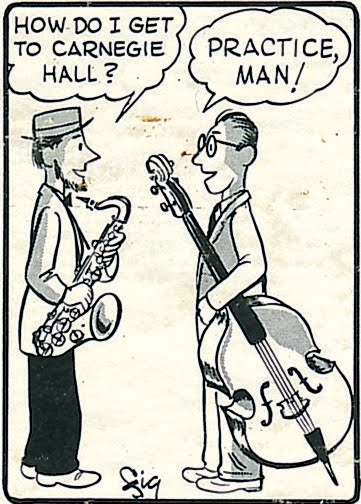
carnegie-hallHis suggestions are all well and good, and I certainly support the idea that we should start with what we can do.  But, isn’t it a bit like telling a young piano student to spend less practicing scales, and more time performing at Carnegie Hall?

Mindfulness is a natural state, and anyone can do it. But, the capacity to actually be mindful throughout the day with any kind of consistency or continuity, and especially in demanding situations – that requires practice. Only consistency and repetition can create new habits.

For every example he gives of a meditator that did not become a better or happier person, we could easily produce many more who have seen positive changes as a result of practicing. Most meditators I know are pretty enthusiastic about that!

In fact, getting attached to those wonderful results can become its own obstacle in meditation (or yoga, or music, for that matter).  Here’s the thing: meditation is a process-oriented activity, rather than a product-oriented activity.  It’s worth doing because sitting with ourselves is inherently worthwhile. Process-oriented activities can be rather mysterious – you don’t think you’re getting anywhere, and then a huge insight arrives, seemingly out of nowhere. But it’s not out of nowhere – it was percolating all of that time when you thought your practice was stuck in neutral.

Recently, one of my dedicated yoga students asked out loud (jokingly) during class, “When are my hamstrings ever going to get more flexible?”  I said (jokingly), “April 23rd.”  Because no one knows!  It’s a process.  We may have things we’d like to have happen, good intentions, and aspirations, but getting hung up on them is a distraction that creates doubt and frustration, which can impede progress.

A product-oriented mindset needs to see results. That is fine for many activities, and can help us be successful in life. However, it doesn’t always apply well to the work we want to do with our body/mind.

I recently listened to a talk by the well-known meditation teacher Sharon Salzberg, who explained that the word that we translate as “meditation” is “bhavana” in Pali (the language of the early Buddhist writings).  Bhavana means “cultivation,” and was a deliberate reference to sowing seeds and waiting for them to grow that would have been meaningful in the agrarian society of the time. Notice the difference between “cultivation” and “acquisition.” Most of us modern urbanites go out and purchase our food and essential items, acquiring what we need by using the funds we acquired from the ATM, where we deposited the money we acquired from our employer for the work they acquired from us.  So, no wonder asking us to slowly cultivate something is a tall order – it’s a little foreign to our time and place.

Still, we all do have the capacity to experience mindfulness and savor our moments. Countless practitioners before us have found that we can be a lot happier if we learn to enjoy the process and take a break from the pressures of delivering a good ROI (Return On Investment)…at least when it comes to time spent in meditation.

The unconscious IS the body

“The great error of modern psychology has been to speak of the unconscious as though it were some kind of unknowable…But insofar as the unconscious is the body…the unconscious can be known and studied…And insofar as it is a timeless principle, the unconscious can be finally realized in an act of unitive knowledge.” – Aldous Huxley

Alignment Maligned: The Baby and the Bathwater

There’s been an article circulating around yogi social media circles today that’s ruffled a few (normally) well-aligned feathers: “Six Reasons You Should Stop Obsessing Over Alignment in Yoga Class” by Maya Devi Georg.  I came across it on Facebook this morning, actually through Matthew Remski’s comments on the article. It touches several nerves connected to current debates on how to make yoga safer, how we relate to our physical bodies, and what is the true significance of this practice.

The quotables from Georg’s article include:

“Obsessing on alignment keeps all the emphasis on the asana and the body. It also emphasizes a level of detail that will neither prevent injury nor make the pose more visually appealing.”

And somehow also this: “When a teacher over-talks, giving far too many details about the alignment of a pose, it takes the student out of their body and into their mind.”  (Wait, where are we stuck? Body or mind?)

And, my favorite: “If you must wait to master one pose before you can begin working on another, you will wait, sometimes for years, while your body loses flexibility and strength. Besides, how long do you want to work on tadasana?”  (Tadasana is Mountain Pose, for those who’ve forgotten your Sanskrit.)

Clearly, the article was meant to be a bit provocative (it includes a little profanity and a lot of attitude), and I admit my first reaction to it was a bit snarky. Here’s my comment on Matthew Remski’s Facebook thread: “I don’t get the sense that she’d be interested in this (see comment “How long do you want to work on Tadasana…”), but if she wants to forget about alignment and just meditate, it sounds like she should just sit down on a zafu and get to it!”

Ok, maybe that was a little harsh, because I don’t know her, and maybe she is serious about meditation. But since the article brought up Patanjali, I think it’s fair to guess that the asanas he had in the back of his mind when writing “the pose should be steady and easeful” looked more like this:

meditatingmodel-on-red-cushion1

than this:

crazy_yogapose

That’s an educated guess, because Patanjali actually did not describe any physical postures in the Yoga Sutras (c. 150 CE), and the related commentary text Yoga-Bhashya, written by Vyasa in the 5th Century, details 11 asanas, all of which seem to be seated meditation postures.

Putting that aside, I actually agree with some of Georg’s points, but not the conclusions she draws from them. Even though it is challenging to teach alignment in a well-integrated way, that does not mean we should throw the baby out with the bathwater.

It really IS challenging to teach alignment without being overly technical and cerebral, inadvertently encouraging students to remain stuck “in their heads.”  But this doesn’t mean alignment instruction has to be a distraction. Ideally, there is a huge sensory aspect to learning alignment. Students shouldn’t be looking around saying “Am I doing this right?” but rather feeling into the pose to discover how any particular alignment principle applies to them.

And, there definitely ARE lots of anatomical variations – ranging from actual skeletal differences that no amount of yoga will change, to injuries or muscular imbalances that may prevent the full realization of a particular alignment principle on any given day. But that’s OK, because alignment is not really supposed to be about aesthetics. Yoga teachers are not sculptors!  And alignment is not about making each person meet some universal standard – in order to truly be safe, it must make allowances for students’ actual bodies and meet them where they are.

In my experience, students (myself included) do not always know when they are misaligned in a pose. It may or may not feel “off.” Sometimes we don’t understand right away what a pose is about, what parts of the body it is targeting, and what alignment would mean in that pose unless someone teaches us how to envision and FEEL it.  And, when all the body weight is dumping into the arms in Downward Facing Dog, and a teacher helps you with that, it is an act of compassion. When a teacher makes you work on Dolphin Pose for a long, long time before teaching you Headstand, that is also compassion.  And smart. And safer for your neck, which is no small thing.

Alright…this rant is almost finished, but here are a few of my thoughts about alignment, which I hope will be the quotables from this article:

Alignment in yoga is key to safety, but it has power beyond that. Taught well, it can awaken unconscious, dormant, underused parts of the body (and mind).

Proper alignment can sometimes feel foreign, even uncomfortable, at first. “Familiar” is not the same as “aligned” because yoga is supposed to expose our habits.  This is one way in which yoga is more about undoing than doing.

Focusing in on a subtle point of alignment can be an excellent way to develop concentration, rather than a distraction. Alignment should help to bring the body and mind together, or in other words, heal the “body/mind split” most of us are living with.

I respect that there are other approaches and perspectives, and especially Georg’s intention to make the asana practice more of a meditation.

But, how long do I want to work on Tadasana?  For the rest of my life! It will be useful as long as standing upright is part of my daily repertoire…and standing still is actually a great way to meditate.