Audio Guided Relaxation – Extending the Exhales

breatheThis past weekend, I started experimenting with recording myself doing some of my favorite guided relaxations and breath exercises. I teach these in my yoga classes all the time, so I thought it would be fun to have some of them to share beyond the studio.

My husband was the guinea pig, and he came into my home yoga space to let me guide him through a few breath exercises while I recorded. I didn’t script these in advance, I just improvised them, because I wanted it to feel like being in a real class.

So, here is one entitled “Extending the Exhales.” This one is especially good to do if you’ve been feeling stressed or overstimulated. Towards the end, it includes the affirmation, “What I need comes to me in the right moment.”

Audio Guided Relaxation – Extending the Exhales

Enjoy and let me know what you think!

P.S. There is another one called “Coming to Center,” which is available on my website for those who are interested in signing up for my “Tips & Inspirations” emails. 🙂

Practice Notes – Simplicity

I am always looking for ways to create more continuity between my meditation practice and my asana practice. One way I do this is by trying to include both asana and seated meditation in the same session, so they flow into each other as naturally as possible. Yet, I find that I often get distracted during the active asana part – thinking about how best to sequence a set of poses for myself, or unintentionally turning my practice into a planning session for the next class I’m going to teach. So, today was all about simplicity.

I decided to simplify the asana practice by narrowing it down to two or three main poses, along with a couple of warm ups and release poses. Without pre-planning the routine, I just picked Downward Facing Dog and Warrior 2, following an instinct for what would feel good today, while sticking with basic poses that don’t require a lot of thoughtful warm up and preparation. I circled back to the main two poses several times, and made a point of noticing specific aspects of the pose or physical sensations each time. I also held them for a long time (maybe 10-12 breaths, but I wasn’t counting) to give the space for really being in the shape mindfully. The asana part was sandwiched in between walking meditation and seated meditation to emphasize the intention of continuity.

Here’s what it ended up being:

  • Walking Meditation with noting (10 mins) – I do this inside, making a “walking lane” just a little longer than my mat.
  • Half Sun Salutations, noting the movements (similar to the noting in the walking meditation)
  • Cat/Cow, noting the sensations
  • Downward Facing Dog – mostly noticing the feet and legs
  • Lunge – mostly noticing the foot’s contact with the floor and the sensation in the hip
  • Downward Facing Dog – more attention on the hands and shoulders
  • Child’s Pose
  • Downward Facing Dog – refining the alignment in the shoulders and arms, mindfully noticing the details and sensations
  • Warrior 2 – most attention in the back leg and foot, feeling how the muscles engage, direction of energy
  • Wide-Legged Forward Fold (Prasartia Padottanasana)
  • Warrior 2 – engaging the legs by isometrically drawing them in toward each other, feeling the sensation of this
  • Standing Forward Fold (Uttanasana)
  • Warrior 2 – engaging the legs by isometrically reaching them away from each other, feeling the sensation of that
  • Downward Facing Dog
  • Legs Up the Wall Pose
  • Eye of the Needle with foot on wall (hip stretch)
  • Seated Meditation (30 minutes)
  • Savasana (10 minutes)

That’s it! This worked well for me today, so I’ll be playing around more with the simplicity of looking more deeply at just a few poses. Try it and let me know if it helps you to sustain your mindfulness a little better!

The unconscious IS the body

“The great error of modern psychology has been to speak of the unconscious as though it were some kind of unknowable…But insofar as the unconscious is the body…the unconscious can be known and studied…And insofar as it is a timeless principle, the unconscious can be finally realized in an act of unitive knowledge.” – Aldous Huxley

Alignment Maligned: The Baby and the Bathwater

There’s been an article circulating around yogi social media circles today that’s ruffled a few (normally) well-aligned feathers: “Six Reasons You Should Stop Obsessing Over Alignment in Yoga Class” by Maya Devi Georg.  I came across it on Facebook this morning, actually through Matthew Remski’s comments on the article. It touches several nerves connected to current debates on how to make yoga safer, how we relate to our physical bodies, and what is the true significance of this practice.

The quotables from Georg’s article include:

“Obsessing on alignment keeps all the emphasis on the asana and the body. It also emphasizes a level of detail that will neither prevent injury nor make the pose more visually appealing.”

And somehow also this: “When a teacher over-talks, giving far too many details about the alignment of a pose, it takes the student out of their body and into their mind.”  (Wait, where are we stuck? Body or mind?)

And, my favorite: “If you must wait to master one pose before you can begin working on another, you will wait, sometimes for years, while your body loses flexibility and strength. Besides, how long do you want to work on tadasana?”  (Tadasana is Mountain Pose, for those who’ve forgotten your Sanskrit.)

Clearly, the article was meant to be a bit provocative (it includes a little profanity and a lot of attitude), and I admit my first reaction to it was a bit snarky. Here’s my comment on Matthew Remski’s Facebook thread: “I don’t get the sense that she’d be interested in this (see comment “How long do you want to work on Tadasana…”), but if she wants to forget about alignment and just meditate, it sounds like she should just sit down on a zafu and get to it!”

Ok, maybe that was a little harsh, because I don’t know her, and maybe she is serious about meditation. But since the article brought up Patanjali, I think it’s fair to guess that the asanas he had in the back of his mind when writing “the pose should be steady and easeful” looked more like this:

meditatingmodel-on-red-cushion1

than this:

crazy_yogapose

That’s an educated guess, because Patanjali actually did not describe any physical postures in the Yoga Sutras (c. 150 CE), and the related commentary text Yoga-Bhashya, written by Vyasa in the 5th Century, details 11 asanas, all of which seem to be seated meditation postures.

Putting that aside, I actually agree with some of Georg’s points, but not the conclusions she draws from them. Even though it is challenging to teach alignment in a well-integrated way, that does not mean we should throw the baby out with the bathwater.

It really IS challenging to teach alignment without being overly technical and cerebral, inadvertently encouraging students to remain stuck “in their heads.”  But this doesn’t mean alignment instruction has to be a distraction. Ideally, there is a huge sensory aspect to learning alignment. Students shouldn’t be looking around saying “Am I doing this right?” but rather feeling into the pose to discover how any particular alignment principle applies to them.

And, there definitely ARE lots of anatomical variations – ranging from actual skeletal differences that no amount of yoga will change, to injuries or muscular imbalances that may prevent the full realization of a particular alignment principle on any given day. But that’s OK, because alignment is not really supposed to be about aesthetics. Yoga teachers are not sculptors!  And alignment is not about making each person meet some universal standard – in order to truly be safe, it must make allowances for students’ actual bodies and meet them where they are.

In my experience, students (myself included) do not always know when they are misaligned in a pose. It may or may not feel “off.” Sometimes we don’t understand right away what a pose is about, what parts of the body it is targeting, and what alignment would mean in that pose unless someone teaches us how to envision and FEEL it.  And, when all the body weight is dumping into the arms in Downward Facing Dog, and a teacher helps you with that, it is an act of compassion. When a teacher makes you work on Dolphin Pose for a long, long time before teaching you Headstand, that is also compassion.  And smart. And safer for your neck, which is no small thing.

Alright…this rant is almost finished, but here are a few of my thoughts about alignment, which I hope will be the quotables from this article:

Alignment in yoga is key to safety, but it has power beyond that. Taught well, it can awaken unconscious, dormant, underused parts of the body (and mind).

Proper alignment can sometimes feel foreign, even uncomfortable, at first. “Familiar” is not the same as “aligned” because yoga is supposed to expose our habits.  This is one way in which yoga is more about undoing than doing.

Focusing in on a subtle point of alignment can be an excellent way to develop concentration, rather than a distraction. Alignment should help to bring the body and mind together, or in other words, heal the “body/mind split” most of us are living with.

I respect that there are other approaches and perspectives, and especially Georg’s intention to make the asana practice more of a meditation.

But, how long do I want to work on Tadasana?  For the rest of my life! It will be useful as long as standing upright is part of my daily repertoire…and standing still is actually a great way to meditate.
Continuity of Meditation & Asana on Retreat

I’ve been back from my retreat at Spirit Rock for a week now, and I’m finally finding some time to share my experiences. One of my main interests in blogging is to talk about the continuum between mindful movement (yoga) and mindful stillness (seated meditation) in my practice. I don’t always find it easy to identify that continuum, but I want to make it stronger so that my yoga and meditation practices can support each other better.

spiritrock_bell

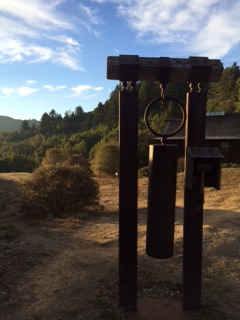
The bell at Spirit Rock that calls retreatants to sitting sessions.

Not surprisingly, this is all a lot easier on retreat! While it was mostly a meditation retreat, alternating between 45 minutes of sitting meditation and 45 minutes of walking meditation for most of the day, we also had the opportunity to attend yoga classes at least once a day.

These yoga classes were an absolute life saver.  Whoa. Let me tell you…when you do that much sitting day after day, the yoga is huge in relieving the tensions, aches, and pains that accumulate in the body. My achiness peaked on the third day, but after that, I actually felt MORE open and comfortable in sitting.

I also found the yoga supported my sitting practice in a second major way: it built up my energy. I have the tendency when I start to get calm and concentrated, to go too far in that direction, and I fall asleep. This didn’t happen when I first started meditating, because I had all that restless agitation to keep me awake! I have been working on balancing the energy level in sitting, so that I can be calm and concentrated, but also vibrant and alert. Each time I took a yoga class on the retreat, I felt energized for the next sitting session. Much like the disappearance of my achiness, over the course of the retreat, I found I was struggling less with sleepiness.

One of the Buddhas at Spirit Rock

One of the Buddhas at Spirit Rock

The yoga practice itself felt more mindful – like a logical extension of the sitting and walking we’d been doing. I think there are a several reasons for this:

  • Continuity is supported by the retreat itself – not just concerning the yoga, but through all activities (eating, walking from one place to another, taking a shower). Everything is part of the practice.
  • Being surrounded by dozens of other students doing the same practice you are, with the same (or at least similar) intentions. This feels different from going to a public yoga class where people are gathering from all kinds of different places, each bringing in their own busy energy, and each with their own goals for the practice, ranging from the sublime to the superficial.
  • The silence of the retreat helps you to get out of your head. When you’re a yoga teacher and you attend another teacher’s class, it’s hard not to go into an analytical space as you experience their style, cues you like/dislike, etc. In a silent retreat, the students don’t speak, but the teacher does – but her words were chosen carefully, and she wasn’t just speaking to fill the space. And, probably it goes without saying, but these yoga classes were done without music. No distractions.
  • The presence of the teacher herself. The yoga teacher participated in most of the seated meditation with us, came to the nightly talks, and was really integrated into the retreat. She was operating at the same speed as us.
  • The yoga was simple.  No elaborate or super challenging poses, and the poses were given without an abundance of technical alignment cues. Normally, I teach a very alignment-based form of Hatha Yoga, but it’s always a fine line to teach with precision without making the practice too cerebral. The simplicity of this practice on retreat allowed us to just stay present with the body.
  • And, the yoga was just what we needed. The focus of the yoga was on reinforcing the themes of the retreat, and preparing the body for sitting. We were opening the hips, releasing the shoulders, and turning towards the body with kindness, rather than emphasizing fitness, technique, or the attainment of particular poses. Not that these goals are always a problem, but they can actually compete with the intention to make the asana a meditative experience.
  • The asana practice didn’t overuse one’s physical energy to the point where you collapse into savasana at the end. When I go to a more vigorous class, sometimes I leave feeling drained rather than relaxed. That’s a sign of overusing energy. I know some students are so wound up, they feel like exhaustion is the only way to actually relax in savasana at the end. But, ideally, yoga balances the energy rather than draining it. True relaxation is not the same as exhaustion or dullness.

Origin Story

Every new blog has to start by explaining its existence, right?  Mostly kidding.  But, in my experience, the first post is the hardest.  So, I thought I’d start by talking a little about what I hope to explore here.

I am a yoga teacher and a pretty dedicated meditator.  I’ve been practicing yoga for about 15 years, and now specialize in teaching Therapeutic Hatha Yoga,  as well as Yin Yoga.  Many of my students have injuries or ailments that yoga helps them address, from this gentle, healing approach to the physical practice.  I added Vipassana (Insight) Meditation to my practice about seven years ago, which gets us to part of the reason for this blog.

I started meditating because I recognized that there’s a whole body of teachings and practices that would help me work with the mind more than my asana practice had so far.  But, from there I began to feel that I had developed two separate practices – one of yoga asana, and one of meditation.  Each was hugely beneficial on its own, but I began to wonder…why doesn’t this feel like it’s all part of ONE unified practice?

It’s not that I expect the same results from two different activities, but the continuum between them has felt a bit murky. I also recognize there are some real philosophical differences between the lineages that produced modern Hatha Yoga and the Buddhism from which my meditation practice developed.  Nonetheless, both are part of my human quest for wholeness, so I want my yoga and my meditation to “talk” to each other as much as possible!  I’m sure the separation is really something that exists more IN my mind that outside of it, but trying to bring my practices together is an attempt to resolve that avidya itself (avidya = misperception).

One last thought about the origin and motivation for typing my thoughts up on this blog.  Everyone who’s been around yoga for a while has heard some version of this idea: “Yoga is not just about the physical postures, it is meant to prepare the yogi for meditation.”  And yet, I know for a fact that many yoga students, despite being rather adept at poses, are quite intimidated by the idea of sitting still in meditation!  It would be extremely hard to find a mainstream Hatha Yoga class that say, ended with 20 minutes of seated meditation.  My main question is: “What’s up with that???”

I may not be the only one with a mental dividing line between asana and meditation!  Could we be practicing and teaching in ways that would encourage more crossover between the two?

Let me know if you have thought about this topic, too…I’d love to hear from you.

P.S. If it seems like I’m just picking on yogis who don’t meditate, I also think there are plenty of meditators who need to locate their actual bodies through some sort of physical practice like yoga! 🙂